

Removing limescale spots from car windows without scratching the glass
Daniel von Detailing1 |


Koch-Chemie × COLOURLOCK
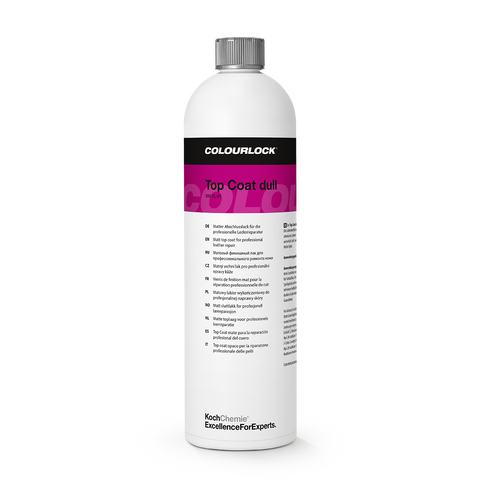
COLOURLOCK "Top Coat" (Dull) Matte Sealing Lacquer for Professional Leather Repair
Matt Topcoat for Leather Surfaces
Koch-Chemie × COLOURLOCK
Topcoat for leather repairs – durable finish with an OEM look
Koch-Chemie × COLOURLOCK
COLOURLOCK "Top Coat" (Glossy) Glossy finishing lacquer for professional leather repair
Glossy topcoat with a brilliant finish for leather
Koch-Chemie × COLOURLOCK
COLOURLOCK "Top Coat" (Compact / Dull) Matte Finish Coat for Professional Leather Repair
Matte topcoat for robust and OEM-matte leather repairs


Koch-Chemie × COLOURLOCK
COLOURLOCK "Top Life" Surface Protection After Dyeing
Surface protection for dyed leather to increase durability
Koch-Chemie × COLOURLOCK
COLOURLOCK "Top Coat" (High Gloss) high-gloss finishing lacquer for professional leather repair
High-gloss top coat for maximum brilliance and protection
What is Top Coat & Finish from COLOURLOCK? The clear final layer of leather dyeing: a pigment-free, elastic film over the color that absorbs abrasion and determines the degree of gloss — from matte factory look to satin or mirror finish, plus a surface protection for freshly dyed leather.
Top Coat & Finish from COLOURLOCK is the final step in the dyeing process: degreasing, priming, filling, dyeing — and then sealing. The Top Coat itself contains no pigments. It lies over the color layer as a clear, stretchable film, absorbs the friction from jeans seams, belt buckles, and entry points, and determines how much light the surface will later reflect. Whether it is matte, satin, or glossy is not a matter of taste in a vehicle, but a factory specification.
Practical tip from Detailing1: A matte Top Coat is not a homogeneous liquid. The matting agents inside are fine solids that sink to the bottom in a standing bottle. If you only swirl it briefly and start spraying, you will get two different gloss levels from the same bottle: the first area will be glossier than the last. Therefore, stir thoroughly before mixing instead of shaking — shaking draws in air bubbles that end up as craters in the film. And only mix as much crosslinker as you will spray in the next hour. Mixed material should never be put back into the bottle: it will continue to react there and spoil the rest.
A freshly dyed seat bolster looks flawless on the evening of the work. Without a final layer, it will be shiny again after a few months — pure leather dye has almost no resistance to friction.
Colors and Top Coats are water-based polyurethane and acrylate dispersions: tiny polymer spheres float in the water; as it evaporates, they move closer together and fuse into a closed film. This film must be able to withstand the compression of the seat surface when entering, which is why the binders are designed for elasticity and can handle stretching in the triple-digit percentage range. For you, this means the structure remains flexible as long as it is applied in many thin layers instead of one thick one.
The division of labor in the structure is clear. The color provides opacity and tone, the Top Coat provides resistance. It is the sacrificial layer: jeans seams, belt buckles, and sleeves work themselves into the clear film, not into the softer pigment layer underneath. This is precisely why an aged surface can be refreshed later without redoing the entire color structure.
A second effect is only noticeable on light-colored leather: the closed film also acts as a barrier to the inside. Dark textile dyes from jeans migrate into an open leather surface due to heat and friction, causing beige seats to look gray-blue after two summers. On an intact Top Coat, this dye remains on the surface and can be removed with a leather cleaner. Translated: The final layer not only spares you from abrasion but also from discoloration that would otherwise only be removable by re-dyeing later on.
What we at Detailing1 observe time and again: inquiries about re-dyed seats that bleed onto clothing, remain sticky, or are worn through again after one winter almost never involve the color. It is the finish that is missing. It is omitted because the area already looks good after dyeing — the difference only becomes apparent after the third month on the driver's seat.
All Top Coats in this category are colorless and differ in exactly two points: how much light they reflect and how concentrated they are.
For modern automotive leather, matte is the standard case. The matte Top Coats cover this: COLOURLOCK "Top Coat" (Dull) as the standard for seats, steering wheels, and door panels, available in 250 ml and 1000 ml / 1 liter, plus COLOURLOCK "Top Coat" (Compact / Dull) as a highly concentrated version for businesses that seal large areas per week. Both create the diffuse, unobtrusive finish that factory-standard leather wears.
COLOURLOCK "Top Coat" (Car and Funiture) is the all-rounder of the line and the choice when the gloss level is not at an extreme, but is to be set between matte and glossy. Furniture edges, seat bolsters, and bags are treated with it just as much as steering wheels. Those who mix their own finish usually work with this base.
The opposite side is occupied by the glossy Top Coats with COLOURLOCK "Top Coat" (Glossy), which visibly deepens the color effect and is at home on furniture, bags, and decorative surfaces, as well as the High Gloss with COLOURLOCK "Top Coat" (High Gloss) for the patent leather look, where the surroundings are mirrored in the surface. Slightly different is the Surface Protection: COLOURLOCK "Top Life" places a thin, transparent layer over freshly dyed leather without changing its feel or existing gloss level — the pragmatic way to secure a color refresh if a full paint structure is not planned.
A perfectly matched color tone saves nothing if the surface reflects light differently than its surroundings. The eye recognizes the difference in light refraction faster than a color deviation.
The gloss is adjusted in two ways. The first is the mixing ratio of matte and glossy Top Coat, stirred and dried on a test area until the value is right. The second is via the additives: the Matting Additive COLOURLOCK "Duller" reduces the gloss steplessly without you having to change anything in the base mixture. Both methods can be combined; it is only important that you stick to one and do not switch in the middle of an area.
The second lever is the feel, and it is regularly underestimated. The feel additives COLOURLOCK "Soft Slip" and COLOURLOCK "Wax Slip" settle into the surface of the film and reduce the friction coefficient: velvety for one, waxy-smooth for the other. There is more to it than just haptics. A finish that is too "grippy" sticks minimally to clothing and then releases jerkily — this is the stick-slip effect that creates the creaking noise in cars when maneuvering. In everyday life, you only notice one thing: the seat remains silent.
That leaves consumption. A concentrated setting like COLOURLOCK "Top Coat" (Compact / Dull) contains more solids per liter and covers correspondingly more area — useful if entire upholstery sets are processed regularly. For the individual seat bolster in your own vehicle, the standard setting is the less complicated choice because it is processed exactly as it comes out of the bottle.
The finish only begins once the color is completely dry. Anything else traps residual moisture and clouds the film, making it milky.
Before that, there is a gentle intermediate sanding with a fine pad, which cuts off dust inclusions and small runs from the color layer. Then the Top Coat is mixed: set the gloss level, stir in one to two percent crosslinker freshly — one percent is enough for furniture leather, two belong on heavily used car surfaces. Spray with low pressure of around two bar from a distance of 15 to 20 centimeters, in one or two fine cross-coats with intermediate drying. Two thin layers beat one thick one, always.
Perforated seats demand an extra round of attention. Anyone who hits them with full material flow will clog the ventilation holes and disable the seat climate control. Professionals therefore intentionally spray the perforation drier: more distance, less material, multiple passes. Pores that have become clogged despite this must be cleared by hand before curing.
Two conditions also decide, and both are rarely in the manual: temperature and humidity. Water-based systems need a minimum temperature so that the polymer spheres flow into each other at all when drying — on a cold surface in an unheated room, the film remains powdery instead of closed and wears off again quickly. High humidity prolongs drying and simultaneously accelerates the reaction in the mixing cup. Both together make a cold, damp November day the worst time for a Top Coat.
After that, only time counts. After one to two hours, the surface is dust-dry, but it is only resilient after 24 to 48 hours. From our experience, this is exactly the point where most repairs suffer: the vehicle is driven again that same evening, and the seat surface gets its first jeans seam in a film that is not yet finished. And as long as the Top Coat is intact, no re-greasing care product belongs on it — grease has no place on a closed lacquer layer; instead, a leather sealer should be used, which reduces the friction coefficient.
A Top Coat is a film-forming layer. Wherever exactly this film destroys the material, the category ends — and that includes more surfaces than the data sheets reveal at first glance.
Open-pored aniline leather, nubuck, velour, and Alcantara are among these. They thrive on an absorbent, velvety surface; a closed lacquer film turns them into a stiff, plastic-like material and robs the leather of the exact character for which it was once chosen. For these substrates, there are separate, film-free paths in the color refreshers.
The hardest limit is on the predetermined breaking seams of side airbags. Such a tear seam must not be painted over, glued, or stiffened by hard crosslinkers — even a slightly increased tear resistance can delay the deployment in the millisecond range. Work on or directly next to this seam belongs in a specialized upholstery shop with certification for pyrotechnic restraint systems, not in DIY.
Two other points that we frequently have to clarify: a Top Coat does not repair anything. Cracks, holes, and brittle areas are filled and stabilized beforehand, the color layer comes from the leather dyes — the clear finish merely preserves the condition it finds. And the supposed leather seats of modern vehicles are often synthetic leather on door panels, headrest backs, and outer bolsters. This requires its own adhesion promoter from the primer and a significantly higher dose of crosslinker, otherwise the plasticizer-rich substrate will repel the film or the surface will become sticky when warm.
Honestly classified: if you want to refresh a single tired seat bolster on your own car and do not own a spray gun, the painting route is the wrong path. It is better to work with a color refresher that already combines color and finish and can be applied with a sponge. The Top Coat category begins where the surface is sprayed and the result must hold its own next to an original part.
The selection is based on two questions: how does the surface right next to it shine, and how much area are you sealing per year? The rest is fine-tuning.
For standard leather in a car with the typical matte factory look, COLOURLOCK "Top Coat" (Dull) is the direct path. Anyone who wants to hit the gloss between matte and glossy themselves starts with COLOURLOCK "Top Coat" (Car and Funiture) as a base and adjusts via mixing or matting additives. If area is processed regularly, the concentrated Compact setting saves on containers. Furniture, bags, and decorative parts that are allowed to have a sheen get COLOURLOCK "Top Coat" (Glossy), the patent leather look is created with COLOURLOCK "Top Coat" (High Gloss).
That leaves the special case without a complete lacquer structure: a color refresh that should only be protected against friction gets COLOURLOCK "Top Life" — it places itself over it as a thin layer without changing the feel and gloss level. The entire process before that — degreasing, priming, filling, dyeing — can be found one level up: Back to Dyeing & Finish.
And the trick that separates professionals from occasional users costs thirty seconds: write down your mixing ratio and stick the note to the bottle. In two years, the neighboring area will be due — the other seat bolster, the second door panel, the passenger seat. Whoever guesses then will hit the color tone again but not the gloss level. Whoever looks it up simply continues the work from back then.
Too much choice in Top Coat & finish by COLOURLOCK? Get help picking:
Daniel von Detailing1 |

Daniel von Detailing1 |

Daniel von Detailing1 |

Daniel von Detailing1 |

Jasper von Detailing1 |

Daniel von Detailing1 |

Daniel von Detailing1 |

Daniel von Detailing1 |

Jasper von Detailing1 |

Jasper von Detailing1 |

Daniel von Detailing1 |

Daniel von Detailing1 |