Applicators for your car: which sponge goes with which product
Daniel von Detailing1 |


GYEON
GYEON Q²M Preserve – SiO₂ plastic protectant for matte black

SONAX
PROFILINE PlasticProtectant "Exterior" Plastic Care
PlasticProtectant Exterior — Silicone-Free Plastic Deep Treatment


CarPro
Car Care Starter Kit with Carrying Case and Premium Care Products


Meguiars
HEAVY DUTY Trim Kit Plastic Care Set
2-step restoration kit for black plastic attachments

Meguiars
Hybrid Ceramic Trim Restorer Plastic Care
Restore Faded Plastic with SiO2 Protection
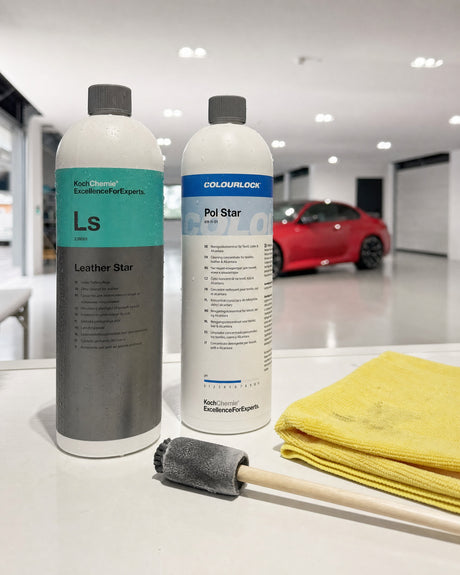
Sun dries leather seats out faster than plastics. Care prevents cracks.
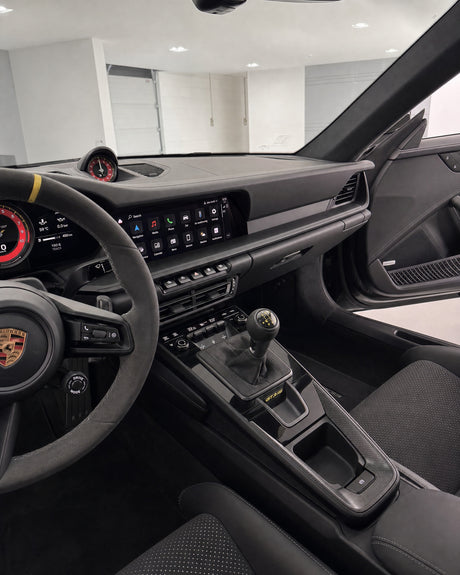
Why your cockpit attracts dust and what antistatic care changes
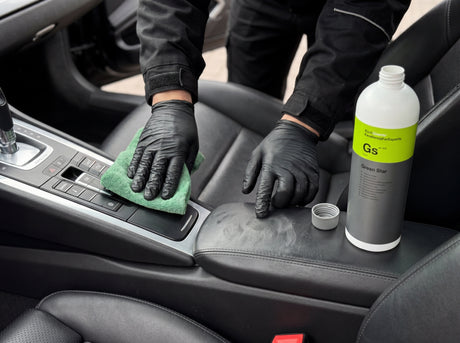
Lift dust and grease, then the plastic dressing absorbs evenly.


Dr. Wack "A1"
A1 "Tiefenpfleger glänzend" Plastic Care
Glänzende Kunststoffpflege für außen, beständig gegen Wagenwäschen


Soft99
Long-lasting protection and revitalization for automotive plastics
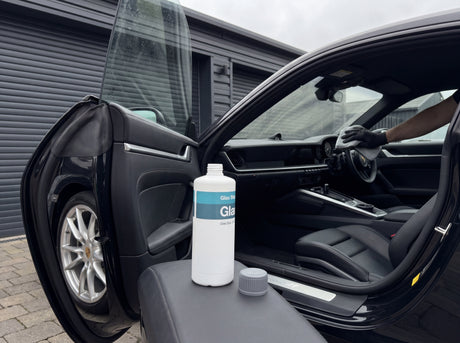
Message us on WhatsApp, from Alcantara to plastics.
What does plastic care do? After cleaning, it lays a thin film with UV absorbers over plastic and rubber. That film slows sun-driven fading, keeps the plasticisers in the material and stops the dashboard and bumper parts from going grey and brittle. At Detailing1 you can choose from Koch-Chemie, Meguiar's, SONAX, GYEON and CarPro.
Plastic care is the protection step after cleaning. It lays down a thin film of silicone oils or polymers and brings UV absorbers with it — molecules that swallow high-energy sunlight and give it off as heat before it breaks the plastic chains apart. Without that protection, plastic loses plasticisers over the years, fades and turns brittle. That goes for the dashboard inside just as much as the bumper strips and wheel-arch trims outside.
Day-to-day from Detailing1: What we see over and over is people laying it on too thick. The logic sounds fair enough — more product, more protection. But plastic can only take up so much; anything past that just sits there as a film, goes patchy-shiny and pulls in dust. So load the dressing onto the applicator, not onto the surface, work it in evenly, let it flash off for two or three minutes and wipe the excess back off with a dry microfibre. That last step is what decides between matt and even or greasy and blotchy. Keep it off the steering wheel and pedals entirely — that's where you need grip.
Plastic in a car ages down two paths, and both run slowly enough that you only notice them once they're already showing.
The first path is UV radiation. Sunlight in the ultraviolet band carries enough energy to cut through the plastic's long molecular chains. The surface goes microscopically rough, scatters the light diffusely and so reads grey instead of black. In practice you spot it when a surface looks dull even though it's clean — washing won't fix it at that point.
The second path is the loss of plasticisers. Those are the additives that keep plastic flexible. Over the years they migrate to the surface and evaporate, sped up by heat. The plastic hardens and picks up fine cracks under mechanical load. On door seals that's exactly why they freeze fast in winter and tear when you open the door.
Plastic care works on both fronts. The UV absorbers catch the radiation before it triggers the chain-splitting, and the film you lay down slows the plasticisers boiling off. What that means for you: the part stays black longer and stays flexible longer. Neither one comes back once it's gone — faded plastic is faded, so caring for it from new does far more than starting once the damage is on show.
The dividing line in the range runs between two groups of active ingredients, and both have their place.
Silicone-oil dressings give a rich, deep black straight away and soak in fast. Their downside shows up inside: silicone oil is volatile, drifts into the air when it's warm and settles on the inside of the windscreen. The film there is thin and only shows in backlight, where it costs you visibility as a greasy haze. If you're forever complaining about a misted-up screen, this is where to start.
Silicone-free dressings work with polymers. They take a little longer to look rich, and they stay where you put them. That makes them the cleaner choice for the interior. The SONAX PROFILINE PlasticCare Kunststoffpflege belongs to this group.
Outside, the maths flips. There's no glass out there for anything to settle on, but there is rain and the pressure washer. Silicone-based products stand up to that better and deliver the deep black you want on wheel-arch trims and bumper strips. The SONAX XTREME KunststoffGel „Außen" Kunststoffpflege is built for exactly this job.
There's a third group sitting between the two: water-based emulsions. They carry the active finely dispersed in water rather than a solvent, so they soak in more slowly and barely smell. For a car that's used every day that's a real plus — you can hop straight in after treating it without a chemical reek. The trade-off is durability, which comes out shorter than with solvent-based products.
The engine bay has its own answer. The Koch-Chemie Motorplast „Mp" Motorkonservierung is built for heat and preserves plastic covers and wiring looms after an engine wash.
The finish isn't a quality question, it's a location question — and where the part sits answers it.
The dashboard wants matt. It lies almost flat under the windscreen and, with a low sun, mirrors straight into your field of view. Any extra gloss only feeds that reflection. The Top Star „Ts" is our go-to here.
On door cards, the centre console and down in the footwell, reflection doesn't matter — there it comes down to taste. If you like a rich gloss, you'll find it in the Koch-Chemie Cockpit-Super-Pflege „Csp" Kunststoffpflege (Glänzend), with no compromise on protection.
For rubber and soft plastic you get both options. The Koch-Chemie Gummi- & Kunststoff- & Vinylpflege „Gkv" Kunststoffpflege covers seals, cubbies and vinyl surfaces; the glossy sister is the Gummi- & Kunststoffpflege glänzend „Gkg".
Badly faded plastic stays a special case. Once black trim has gone grey and blotchy, the colour is out of the surface and no oil film brings it back. That's why the Koch-Chemie Kunststoff-Färber „Kfs" Schwarz Kunststoffpflege works with pigments instead of oil and puts colour back on. It's cosmetic, with limited durability, and the only alternative to replacing the part.
The routine is short, and the mistakes all happen at the same spot.
Cleaning comes before dressing, and it has to be thorough. Dressing over unclean plastic seals the dirt film in — the result is a greasy surface that grabs dust again faster than before. You'll find the right products for the step before it under Interior cleaners.
The surface has to be dry. Leftover moisture stops the film laying down evenly and leaves cloudy streaks that only show once it's dried. A second, dry cloth after cleaning sorts that out.
Then the dressing goes onto the applicator, not onto the surface. Work it in evenly in overlapping passes, let it flash off for two or three minutes, wipe the excess back off with a dry microfibre. Skip that last step and you get exactly the blotchy, greasy look that gave plastic dressings their dodgy reputation.
Leave the steering wheel, gear lever and pedals alone. A silicone or polymer film on the wheel rim makes it slippery, and that's not a cosmetic problem. If you want the wheel clean, clean it and leave it untreated. Same goes for the seatbelt webbing and the tread areas of the floor mats.
Outside the same routine applies with one addition: weathered plastic parts should be degreased before the first dressing, or the new film sits on the remains of the old one and lasts a lot less time.
One thing that regularly causes grief outside is the edge where plastic meets paint. Plastic dressing on painted surfaces leaves a greasy haze that only comes off with a degreaser, and on a freshly sealed bonnet it kills the water beading. So work with a narrow applicator along the edge and, on wheel-arch trims, run a strip of masking tape onto the neighbouring paint if in doubt. Two minutes of effort saves the half-hour of clean-up.
Durability depends more on where the part sits than on the product. Inside, out of the rain, a good dressing holds a season and more. Outside, the number of washes decides it: every pass with an alkaline shampoo strips part of the film, and the pressure washer speeds that up. Reckon on six to ten washes outside, then it's due a refresh. If you don't want to keep on top of that, you're better off with a sealant.
Our range is compact and covers four areas of use.
For interior surfaces Koch-Chemie has the widest line-up with twelve products, from the matt standard dressing through the glossy version to the water-dilutable concentrate. The line is tuned to work together, so you can mix and match without risking any clashes.
For exterior parts we carry the specialist gels and detailers, among them the SONAX XTREME KunststoffDetailer „Innen+Außen" Kunststoffpflege, which handles both areas and is plenty for cars with little exterior plastic.
For long durability there are the sealants. The SONAX XTREME Ceramic Kunststoff-Versiegelung bonds chemically to the surface instead of just sitting on top. It takes more work to apply, but the life is many times that of a classic dressing. For cars that live outside, that pays off.
Prices run from under eight euros for a small bottle of standard dressing up into three figures for sealants and pro-size containers. For a single car the sensible range sits at the lower end — 250 to 500 ml covers years inside, since each application only needs a few millilitres. If you're doing the exterior too or looking after several cars, the concentrate works out cheaper.
On top of that comes the engine bay, with the Motorplast as its own use case. The THE FINISHER „InsideCare" Innenraumpflege rounds off the range for the interior.
The condition of the plastic decides which product makes sense — and whether dressing is even the right answer any more.
On a new car or a young used one it's all about prevention, and this is where the payoff is biggest. A matt dressing on the interior surfaces twice a year, plus the exterior parts while you're at it, costs half an hour all in. The effect only shows after years, but it shows clearly: a cockpit that's still evenly black after eight years.
On a daily driver with a few years on the clock the condition is usually still good enough for standard dressing. If some spots are already lighter, it's worth a look at where they sit — if it's the sun-facing surfaces, UV is the reason and regular dressing slows the rest.
With a seasonal car or one that mostly sits, it plays out differently than most people assume. A car that's barely driven ages faster inside than a high-mileage one — it's often parked in the sun, the cabin temperature climbs past 60 degrees, and the heat drives the plasticisers out of the material. Twice a year a dressing on every interior surface does more here than any amount of cleaning. A sunshade on the windscreen costs nothing and takes the brunt of it.
On a weathered car with grey, blotchy plastic parts, normal dressing only gives a short-lived effect. It darkens the surface for a few weeks and then washes out. Here the plastic dye is honestly the only option with a visible result, and even that is a stopgap.
If you're planning cleaning and dressing together, you'll find both steps bundled under Interior care. This category is also the care branch of care products in the Washing & Cleaning section.
Too much choice in Plastic care? Get help picking:
Daniel von Detailing1 |

Daniel von Detailing1 |

Daniel von Detailing1 |

Daniel von Detailing1 |

Daniel von Detailing1 |

Daniel von Detailing1 |