

Cracks in the tyre sidewall come from ozone, not from the sun
Fine cracks in a tyre sidewall usually get spotted by accident, at the seasonal tyre change or when the wheel happens to sit in raking light. The first question is almost always the same: would tyre care against cracking have prevented this? The honest answer has two parts. The tyre protects itself, with a chemistry it sweats from the inside out. And that very protection is what many people wash off at every wash without knowing it.
Tyre rubber ages through ozone, UV light, heat and the loss of plasticisers. A tyre brings its own ozone protection with it, and aggressive cleaning strips it away. Gentle cleaning, a solvent-free protectant and cool, dark storage measurably slow the ageing down. Cracks deeper than one millimetre are beyond any care product on earth.
The tyre sweats its own ozone protection to the surface
Tyre rubber is built from elastomers with double bonds in the molecule, and those exact bonds are what ground-level ozone splits, so the polymer chains break and the sidewall under tension develops fine cracks running across the direction of stretch.
Tyre manufacturers have known this for decades and mix a countermeasure into the compound: 6PPD, an antiozonant, at roughly 0.5 to 1.5 percent by weight. The substance is deliberately not fully soluble in the rubber. Over months it migrates to the surface, where it intercepts the ozone before it reaches the chain. What that means for you: the rubber sacrifices a chemical so that it stays intact itself. On top of that, paraffin waxes migrate outward and form a thin film against oxygen and ozone.
Visually this protection shows up as a brownish-grey haze on the sidewall, the blooming we explained in detail in the article tyres turning brown. Anyone who reads the haze as dirt and strips it at every wash with a highly alkaline cleaner or brake cleaner takes the ozone protection down with it. The tyre replenishes it, but not endlessly, and not within a week.
UV light works differently from ozone. High-energy photons split bonds and create radicals that start a chain reaction with oxygen. The result is an embrittled, faded surface that chalks but does not crack first. Heat accelerates both processes and additionally drives the plasticiser oils out of the rubber, which are not firmly bound to the matrix. A tyre that parks three summers in the sun is therefore harder than one from under a carport, even at the same mileage.
One millimetre of crack depth decides the roadworthiness test
Ageing cracks on passenger-car tyres count as a significant defect in the German periodic inspection as soon as they are deeper than 1.0 millimetre or run all the way around the sidewall or tread.
That limit is set in the VdTÜV bulletin 757, which inspection engineers use to judge tyre damage. Anything below it is at the inspector's discretion and is a note, not a reason for refusal. As soon as fabric or cord threads become visible, the decision is made. For commercial vehicles with a high load index the limit is 3.0 millimetres; for your car the one millimetre applies. A toothpick that stays put in a crack is a bad sign.
You read the age off the DOT number, the four-digit block in the oval on the sidewall. The first two digits are the production week, the last two the year, so 1224 stands for the twelfth week of 2024. The ADAC recommends retiring tyres after 8 to 10 years at the latest, winter tyres closer to 8. From the sixth year onward Continental, Michelin and the ADAC advise an annual visual check. For trailers with a 100 km/h approval, German law even sets a maximum age of 6 years.
Where you look matters. Ozone cracks usually sit on the outer sidewall, where sun and air reach, but often also on the inner side that nobody looks at. Cracks between the tread blocks in the groove base come from heat and shear forces under braking. For Sunday that means: once around the car, turn the wheel to full lock, search the inner side with a torch, and only then start cleaning.
Why the hardness of the rubber matters is shown by an ADAC driving test: a tyre with 4 millimetres of remaining tread loses contact on a wet road at just 63 km/h, a new tyre with 8 millimetres only at 87 km/h. A hardened old tyre with full tread also brakes worse, you just cannot see it. That is why a look at the DOT is worth more than a look at the shine.

On Sunday the dry tyre matters more than the product
A protectant only holds on a clean, completely dry tyre, which is why the dry Sunday with 0 percent rain and 23 degrees is the window, while today is still wet.
The routine takes little time, but it needs order. The sidewall gets cleaned with the GYEON Q²M TireCleaner 500 ml, but only if old silicone layers or a thick haze are really sitting on it. The cleaner is alkaline, takes old dressings and bled-out 6PPD with it and therefore does not belong in every wash. How the cleaning and the tyre-before-wheel order work is covered in the article cleaning tyres before tyre care.
On a well-kept tyre the shampoo from the wash and a soft brush are enough. The alkaline cleaner is the tool for a fresh start, not for the routine.
Then comes the part most people skip: drying. Water in the lettering of the sidewall dilutes water-based products and, with ceramic sealants, blocks the bond to the rubber. A separate towel or ten minutes of waiting in the shade is enough. A tyre still warm from driving is just as unsuitable, because the carrier evaporates before the actives have pulled into the pores, and the finish turns patchy.
The application itself is handwork with an applicator, not spraying from a distance. One pump onto the Koch-Chemie Applicator Sponge 2 Stück, then short overlapping arcs across the sidewall, always the sidewall only, never the tread. For a set of tyres, 10 to 15 millilitres of the ceramic protectant is enough.
After about 15 minutes you remove the excess with an old microfibre towel. This step decides whether the product is on the tyre on Monday or on the wing as sling. Then let it cure overnight, ideally until the rain arrives on Tuesday.
Water and ceramic protect the rubber, solvents leach it out
Tyre care against cracking works as a sacrificial layer with UV absorbers and radical scavengers on the rubber, but it neither replaces lost plasticisers nor closes an existing crack.
The actives come from paint technology. UV absorbers such as benzotriazoles intercept the radiation and release it as heat before it reaches the rubber. HALS, hindered amine light stabilisers, trap the radicals that form anyway and regenerate themselves in the process. Translated: the layer ages instead of the tyre. To do that it has to be closed and renewed regularly, otherwise it only protects where it still sits.
The base is where the paths part. The GYEON Q² Tire Ceramic Tire Protecant 500 ml is an SiO2-based ceramic sealant that bonds with the rubber, works solvent-free and stays satin. The manufacturer quotes up to 6 washes of durability; experienced users report 3 to 4 weeks in everyday use. If you want the factory look and do not want to keep touching the tyre, this is the one.
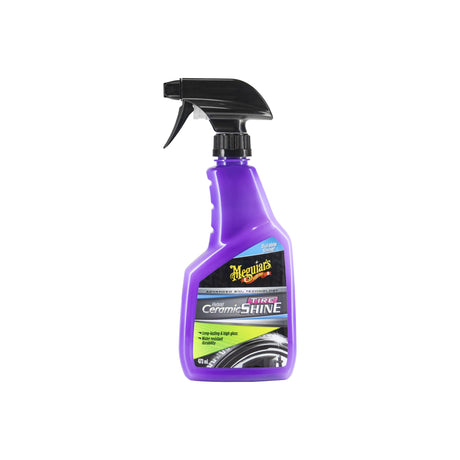
If you want high gloss, reach for the Meguiars Hybrid Ceramic Tire Shine 16 oz (473 ml), a water-SiO2 hybrid that is wiped off after 3 to 5 minutes and survives rain noticeably longer than a pure water-based dressing.
The classic Meguiars GOLD CLASS Endurance Tire Gel 16 oz (473 ml) is a solvent-based polymer gel that is absorbed by the rubber and, according to the manufacturer, stays visible for 7 to 10 days. It explicitly advertises protection against UV damage and browning. Its limit is the dosage: too much gel stays tacky, attracts dust and slings off when you drive away. What none of the three can do is something the manufacturers themselves do not say loudly enough: a crack that is there stays there. The care slows down the next one.

Too much cleaning ages the tyre faster than none at all
Anyone who strips the sidewall with brake cleaner or undiluted all-purpose cleaner at every wash and only dresses it briefly afterwards does more harm to the rubber than someone who never touches the tyre.
Brake cleaner consists of hydrocarbons such as acetone or naphtha. It degreases in seconds, and that is exactly the problem: it takes the 6PPD film and the wax barrier off completely and pulls the plasticisers right behind them. An all-purpose cleaner above pH 13, sprayed on neat, works in the same direction, only more slowly. Both look deep black and clean afterwards. That is the trap, because a bare tyre is left defenceless against ozone for two weeks until the compound has replenished itself.
The second mistake is the aerosol in everyday use. Gloss sprays from a can work with volatile solvents so that they dry smooth without wiping. For show day that is a good trick. As a weekly routine there is the suspicion that exactly these solvents pull the plasticisers out of the surface, and a tyre without plasticisers turns brittle. If you like an aerosol, use it rarely and lay a water-based or ceramic layer underneath in between.
The third mistake is mechanical. Too little air pressure makes the sidewall flex more, it heats up and ages faster, and on top of that the risk of a carcass failure grows. A car that sits for weeks presses the same spot flat every time. And dressing on the tread or on a motorcycle tyre is no longer a question of ageing but of grip. Checking the pressure once a month and looking at the sidewall in raking light costs less than any bottle.
A question that keeps reaching us in the chat: can a rubber care product prevent cracks in the long term? Answered honestly: slow them down, yes; prevent them, no. Tyre care against cracking is an interval, not a one-off protection, and a care product for door seals or pedal rubber does not belong on a tyre sidewall, because it is made for other compounds and no flexing. The tyre gets its own product, every 4 to 8 weeks, applied thin.
The summer tyre keeps ageing in the cellar if it is stored wrong
For stored tyres, DIN 7716 calls for five to 25 degrees, below 65 percent humidity, darkness and a room without ozone sources, otherwise the ageing simply carries on on the shelf.
The bit about ozone sources surprises many. Electric motors with carbon brushes, compressors, welders and old oil burners produce ozone while running, which makes the cellar next to the boiler or the garage with the compressor the worst places for a set of tyres. Direct sun and strongly UV-laden artificial light do not belong in the storage room either. Solvents, fuel and oil sit at least one shelf further away.
Complete wheels are stacked lying flat or hung on a wheel tree, with 0.5 bar more pressure than prescribed, because they slowly lose air over the months. Tyres without rims stand upright and are turned a quarter every few weeks so no flat spot forms.
At least 10 centimetres of clearance from the floor keeps moisture away. Continental additionally recommends packing each tyre in an airtight bag and pressing the air out. That slows the evaporation of the oils from the compound.
A dressing does not belong on the tyre before storage. For the cleaning before the October changeover, shampoo and a brush are enough, then dry completely.
If you store the set at a tyre dealer, skip care products altogether, because the tyres stand tightly packed there and the product leaves marks on the neighbour. The protection for winter on the shelf is temperature, darkness and rest, not chemistry. The care comes back in spring, on the dry, mounted wheel.

Detailing1 insight: In raking light you often only see hairline cracks when it is too late. So press the sidewall lightly with your thumb right next to the DOT oval: under tension, ozone cracks open into a fine web that stays invisible on the relaxed rubber. We do this test on every test vehicle in front of the showroom in Nordhorn as soon as a tyre is older than four summers. On a customer car with five-year-old tyres, the sidewall looked deep black after monthly gloss spray; under the thumb a web appeared that the inspector later rated as borderline. The shine had not slowed the problem down, only hidden it.
No time for the whole post? Get it summarized:
Add Detailing1 as a preferred source on Google