

Acid dissolves limescale spots on car windows, glass cleaner doesn't
After the wash the windscreen looks clean. Then the sun drops low, and suddenly the glass is covered in little white rings that survive a third pass with glass cleaner. That's exactly what customers tell us, often with the line “sorry, only just noticed it”. And the longer they sit, the harder they are to shift. If you want to remove limescale spots from glass, you first need to know whether they're sitting on the glass or already in it.
Limescale spots on car glass are dried-up mineral residue from wash or rain water. While they're still sitting on the surface, an acidic water spot remover dissolves them in minutes. Once they've etched into the glass, only glass polish helps, followed by a sealant that makes new drops bead off and keeps limescale away from the glass.
Limescale spots are minerals left behind on the glass after drying
Limescale spots form when a water drop evaporates on the screen and the dissolved minerals, mainly calcium and magnesium carbonate, stay behind as a white ring. Glass cleaner cuts through grease and dust. It doesn't touch limescale.
That's why the usual reflex goes nowhere. Alcohol-based and surfactant-based glass cleaners are built for oil film, fingerprints and bug residue, so organic dirt. A limescale ring is a mineral deposit, chemically closer to stone. You can buff it with glass cleaner until it shines, but it stays put. What dissolves it is an acid: it reacts with the carbonate and turns it into water-soluble salts that you simply rinse off.
Where the minerals come from depends on where and with what you wash. In Germany, water counts as medium-hard from 8.4 °dH and as hard from 14 °dH, as laid down in the German Detergents Act (Wasch- und Reinigungsmittelgesetz). The harder your tap water, the more material is left behind per drop. Add drops from the lawn sprinkler, the car wash, or an autumn shower that brings dust down from the air onto a warm screen.
You spot the problem faster on glass than on paint, because light passes through the screen. Against a dark interior or the low autumn sun, every single ring stands out. Drive into oncoming traffic and the edges scatter the light, so a cosmetic problem becomes a visibility problem. It hits the areas the wiper doesn't reach hardest: the edges of the windscreen, the side windows, the door mirrors.
Dried-on limescale spots etch into the glass over time
A fresh limescale spot sits on top of the glass and can be dissolved chemically. Leave it for weeks in sun and moisture, and the alkaline minerals attack the glass surface, turning the ring into a shallow dip.
Car glass is soda-lime-silica glass. It's hard and scratch-resistant, but not indestructible: an alkaline mineral film that keeps getting wet and then dries in the sun roughens the top layer at a microscopic level. In the scene people talk about the difference between surface spots and etching, meaning etched-in spots. The surface spot sits on the glass, the etched one sits in the glass.
Time is the deciding factor, but there's no hard cut-off. A ring from last weekend usually comes off with the first acid pass. Spots that have been outside for three to four months, like on one customer's car, are borderline: some dissolve, some stay behind as a faint shadow. If the car also stands in full sun, the balance shifts towards etched.
That's why the job is worth doing right now. Today stays dry in Nordhorn, showers are possible on Tuesday and Wednesday, and on Thursday the chance of rain is over 80 per cent. If you clear and seal the screen beforehand, the autumn rain no longer finds a rough surface where drops can hang on and dry in. If you wait, you lay the next layer on top of the old one.
A second reason is safety. Modern windscreens carry the camera and rain sensor for the driver assistance systems in the upper area. A film of limescale right there scatters light in front of the lens. So you treat the camera zone chemically only, and very gently. Mechanical work has no place there.

An acidic water spot remover dissolves surface limescale in minutes
An acidic water spot remover chemically converts the carbonate into soluble salts. On glass, one to two minutes of dwell time is usually enough, then you rinse thoroughly with plenty of water.
Before you can remove limescale spots from glass, there's a test that sorts the problem in a minute. Start with a normal wash, so dust and sand don't get dragged across the glass with the acid. Then put a clear glass cleaner on a glass towel, wipe the screen in one direction and let it dry. Now hold a torch flat against the glass or look across it towards the sky. Anything you can still see is no longer grease or road film.
The second test is the fingernail. Run your nail over one of the rings. If you feel a slight raised edge, the limescale is still on top. If the spot feels smooth even though you can see the ring, or your nail catches slightly in a dip, the spot is at least partly etched. That tells you which tool to start with, and it saves you the disappointment when the first step doesn't do everything.
For everything that follows, work in the shade and on cold glass. A screen heated by the sun makes any product flash off in seconds, and a dried acid film leaves new rings. Morning or an overcast afternoon is ideal, and the glass should feel cool to your hand.
Be realistic: the first time, a heavily spotted windscreen takes about an hour, including the test, the acid and the final clean. The side windows go faster. The second time you know the routine and you're a lot quicker.
For the main part of the job we use the INNOVACAR "100%" Scale 500 ml. It's acidic, approved by the manufacturer for glass, paint, plastic and polycarbonate, and works on dry and wet surfaces. Apply it section by section, about a quarter of the windscreen per pass. Put it straight onto a folded microfibre cloth and spread it evenly, let it work briefly and rinse before anything dries on. On heavy build-up, do a second pass rather than one long first one.
It's noticeably stronger than a household remedy. Chrome, anodised trim and unpainted aluminium can go dull from it, so wear gloves, tape off those parts and lift the wipers.
If you prefer to work with a pro-grade concentrate, grab the SONAX PROFILINE Waterspot Remover 1000 ml / 1 litre. On paint, SONAX gives a window of one to two minutes and states explicitly that glass tolerates a slightly longer dwell time. You can see it working when the rings turn paler or foam up slightly. Again, apply it targeted instead of misting it everywhere, and rinse with plenty of water instead of wiping with a dry cloth.
Acid is no problem on glass, but it isn't always kind to its neighbours. Wiper blades and window seals can take it, but anodised trim can't, so cover it with a cloth or rinse it straight away. After rinsing, clean the screen once more with glass cleaner and distilled water so no acid residue is left behind. Rinsing with tap water is the classic mistake here, and it builds the rings straight back up.
Once the screen is clear, you're done dissolving and can go straight to sealing. If faint shadows remain in raking light and don't change after a second pass, the rest sits in the glass. More acid won't change that, because it only attacks what's sitting on top.
Etched rings need glass polish instead of more acid
What's still visible after the acid step is a dip in the glass. You only remove that with minimal material removal using a glass polish, by hand or by machine.
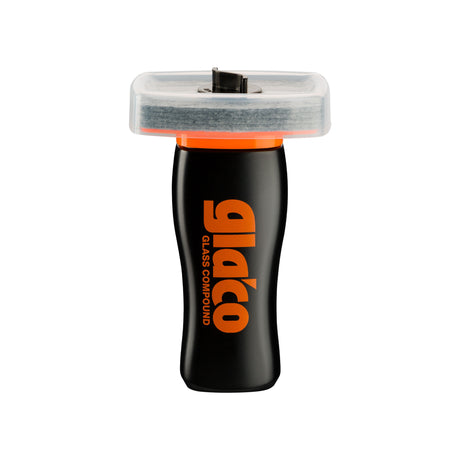
The Soft99 Glaco Glass Compound Roll On is made for exactly this. It works with two particle sizes, small hard ones and larger soft ones, which smooth the surface instead of scratching it. The felt head sits right on the bottle, and a windscreen only needs a few millilitres. Pressure matters: glass is much harder than clear coat, so gentle stroking does nothing here. Work in small sections of about 40 by 40 centimetres, in crossing passes and with firm pressure.
Keep the area slightly damp as you go and check in between. Wipe one section off, rinse it, look at it in raking light. If the rings are gone, move on to the next section. If they're only shallower, do a second pass. Tape off the rubber and plastic around the screen first, otherwise the polish leaves pale marks there that are hard to get out again.
There are limits here too. Glass polish only removes very shallow etching. With a machine the glass heats up quickly under the pad, so on acoustic and head-up screens with a laminated film, keep the speed low and the intervals short.
If a ring is so deep that your fingernail clearly catches in it, or the screen is also scratched by the wipers, polishing has reached its end. In the camera zone of the assistance systems and on heated windscreens with wires, you don't polish at all. There it stays with the chemical step.
One side effect you'll gladly take: the polish also removes old sealant residue, silicone film from the car wash and the grey haze that likes to form in the corners outside the wiper area. After that the glass is as clean as a new sealant needs it to be.

Scouring cream and razor blades scratch the windscreen
Most damage doesn't come from the limescale but from trying to get rid of it with household products or tools. Scouring cream, steel wool and blades leave scratches that bother you more than the spot did.
If you want to remove limescale spots from glass, you almost always try whatever is in the kitchen cupboard first. Vinegar and citric acid really do dissolve limescale, they just aren't made for cars. Vinegar runs into seals and trim, citric acid dries into sticky edges, and you never know the exact concentration. Scouring cream works with coarse particles that put fine scratches into glass. You see them at night against oncoming light as streaks, and they only come out with machine polish.
The blade is the second classic. A glass scraper has its place on glass for taking off stickers or paint splatter. Against limescale it's the wrong tool, because the limescale is firmly bonded to the surface and the blade drags a track over every grain of sand. Around the camera, rain sensor and head-up display it's off limits. A scratch in front of the camera can interfere with the assistance systems, and replacing a windscreen usually means a new calibration too.
The third mistake is the sun. Acid on a hot screen dries in seconds and leaves its own rings, and polish on warm glass smears instead of cutting. And the fourth is rinsing with tap water without drying: if you let the freshly cleaned screen air-dry, you rebuild the spots within the hour.
That's why you need a proper glass towel for wiping off. The THE COLLECTION "Waffle" Waffle-Weave Glass Cloth at 450 GSM soaks up water and residue in the waffle structure instead of spreading it over the glass. A normal fluffy towel leaves lint on glass and drags streaks that you then mistake for new spots.
A sealant before Thursday keeps new limescale off the glass
A windscreen sealant lowers the surface tension of the glass, so water pulls together into beads and runs off before it can dry. That doesn't prevent limescale completely, but new rings then sit on the coating instead of on the glass.
For the windscreen we recommend the Soft99 Glaco DX. According to Soft99 it lasts up to four months, and at 110 ml it covers about ten windscreens. The swivelling felt head follows the curve of the screen, so the coating sits evenly at the edges too. Two verified reviews on Trusted Shops, both with no deductions; we don't have more votes for this product yet. In the rain, water beads off the glass without wipers from about 45 km/h.
The order decides how long it lasts. First dissolve the limescale, then polish if needed, then degrease with glass cleaner and distilled water, then seal. A sealant on limescale has nothing to grip and breaks down quickly, while a sealant on polished glass lasts its full months. Apply the coating in crossing passes, let it haze briefly and take off the excess with the glass towel. After that the screen needs a few hours without rain, and today that works.
Let's be honest: even a sealed screen gets limescale spots if tap water dries on it in the sun. Because the drops dry as tall beads, the rings can even look a bit stronger. The difference is that they sit on the smooth coating and come off with the acidic remover, or even with the next glass cleaner. You're spared the tedious polishing. Seal the mirrors and side windows straight away too, since most of the water there dries off by itself.
Your setup for the dry window before Thursday is therefore manageable: an acidic remover for the surface limescale, a glass polish for what's left, a sealant and a good glass towel. You'll find more in our category Water spot remover and under Window sealing. If the screen smears despite everything, the cause is somewhere else, and we've put the most common ones together in 5 reasons your windscreen smears after summer. Limescale on paint follows its own logic, which is covered in our article Removing Water Spots From Your Car: What Heat Does to the Paint.

Detailing1 insight: On almost every car we get shown, the most stubborn limescale spots aren't in the wiper area but on the door mirrors and along the edges of the side windows. The reason is simple: after the wash, water keeps running out of the mirror housing, the window channel and the trim for minutes, and nobody dries those drops any more. So after drying we fold the mirrors in and out twice, then wipe a second time over the mirror glass and window edges. If you skip that and park the car in the sun, the next morning you'll see exactly the rings you just polished away.
No time for the whole post? Get it summarized: