

Car Abrasive Polish: Abrasiveness, Grit, and the Right System
The most common question we receive before a ceramic coating is: "Do I need to polish beforehand?" The answer is yes — but why it's yes reveals more about abrasive polish than any packaging text. Anyone who only polishes to then seal misses the crucial step of paint correction. Anyone who applies too aggressively removes too much clear coat and faces a problem after two seasons that can no longer be polished. This guide explains which product is made for which scratch.
Abrasive polish removes scratches, swirls, and holograms through mechanical clear coat removal – not by filling or masking. The abrasiveness you need is determined by the polishing grade, grit, and the gloss level the product leaves behind after polishing.
What is abrasive polish: when do you really need it?
Abrasive polish is an abrasive agent that uses the finest abrasive particles to mechanically remove micrometre-thin layers of clear coat. The result: scratches, swirls, and oxidized areas disappear — because the surrounding paint surface is brought to the level of the deepest damage point. This principle fundamentally distinguishes abrasive polish from care polishes or quick detailers, which only fill and optically mask defects without truly repairing them.
You need abrasive polish if swirl patterns or streaking are visible in oblique light — i.e., fine circular scratches resulting from washing with unclean aids. Also, if deep scratches have touched the clear coat without reaching the base coat, if you want to apply a coating to a pristine paint finish, or if the clear coat has oxidized and become dull after years of UV exposure. These are all classic paint correction situations for which abrasive polish was designed.
What abrasive polish definitely cannot do: correct scratches that go deeper than the clear coat. If a scratch goes into the base coat or metal, that's a bodywork job. The quick test: Run your fingernail over the scratch. If it catches, it's too deep for polish. If your nail glides smoothly over it, the scratch is in the clear coat and thus in the correctable range.
Heavy Cut, Fine Cut and Micro Cut: the three polishing classes
Koch Chemie divides its abrasive polishes into a scale from 1 to 10: polishing grade. The higher the number, the more clear coat the product removes per pass. This sounds simple — but in practice it makes the crucial difference between a result in one step and one that requires two or three steps.
In the Heavy-Cut class, Heavy Cut H9.02 works with a polishing grade of 9.0. It corrects sanding marks from P1200 grit, deep swirls, and severe oxidation. The product is formulated without silicone oil — a detail that is crucial when a ceramic coating is to be applied afterwards. Customers consistently report that H9.02 quickly and reliably removes deep scratches, confirmed by verified reviews on Trusted Shops. The Heavy Quick Cut B9.01 works at the same abrasive level, correcting sanding marks from P1500 — and achieves an intermediate result faster.
The Fine Cut F6.01 belongs to the Fine-Cut class. It uses fine aluminium oxide particles and operates at a medium abrasive level. Medium to light defects, initial swirl patterns, slight holograms – that's what the F6.01 is made for. It leaves a high level of finish after polishing, even without post-processing: a polishing grade of 6.0 combined with a gloss grade of 7.0. "Very good polish for medium defects, easy to apply and leaves a shiny finish," confirmed by verified buyers.
The Micro-Cut class consists of the Micro Cut M2.02 and the Micro Cut M3.02. The M2.02, with its anti-hologram formula, is designed for the finishing stage from 4000 grit upwards – the final polishing step after a heavy-cut pass, which removes fine polishing marks and holograms from the surface. The M3.02 also works in this range but is formulated without silicone oil, making it the right choice when a coating follows directly afterwards. Customers specifically mention it for removing fine streaks and holograms, resulting in deep gloss.
The logic of the system becomes clear if you understand the products as a ladder: H9.02 or B9.01 for the maximum correction step, F6.01 for medium defects in one pass, M2.02 or M3.02 as the finishing stage after a heavy-cut. P3.01 and P2.03 complete the system downwards — for situations where little abrasion is sufficient and the result should shine directly. This systematic approach allows you to remove exactly as much clear coat as the degree of defect requires — no more.

Abrasiveness, gloss level, and grit: what the numbers mean
Every Koch-Chemie abrasive polish shows two bars on the label: polishing grade and gloss grade. Polishing grade describes how aggressively the abrasive penetrates the clear coat surface. Gloss grade describes how polished the surface looks immediately afterwards — before you help with another step. Both values together decide whether you work in one or two polishing steps.
The Paint Polish P2.03 clearly demonstrates the principle: polishing grade 2.0, gloss grade 9.3. This means minimal removal, direct high gloss without any subsequent steps. The P2.03 is a one-step product — for vehicles with few fine defects, for regular maintenance correction after the season, or as a final finishing step after a fine-cut pass. The One Cut & Finish P6.02 goes a step further: high-gloss polish with integrated sealant, in case you want to finish directly after a cut step without a separate coating or wax.
The H9.02 has a polishing grade of 9.0 and a gloss grade of 6.0. This means: after the heavy-cut run, the surface is corrected, but not yet finished. A micro-cut step with M2.02 or M3.02 is necessary to remove polishing marks and bring the surface to a high-gloss level. You work in a two-step system: Cut corrects, Micro finishes.
Grit as sandpaper equivalent: The H9.02 corrects sanding marks from P1200, the B9.01 from P1500, the M2.02 works from 4000 grit. This gives you clear guidance on how deep the intervention is. Anything coarser than P1200 is true sanding territory — abrasive polishes no longer help there; sandpaper must be used before polishing can be effectively applied.
Important limitation: A high polishing grade corrects quickly — but also removes more clear coat. For thin OEM clear coats under 80 micrometres or frequently polished vehicles, always measure the layer thickness first and apply a test spot. Too much clear coat removed cannot be restored.
Properly applying abrasive polish: test spot, temperature, and pad pressure
Every paint correction begins with a test spot: 30 by 30 centimetres, one pad, three to five passes — before you work on the entire surface. The test spot shows whether the selected polish-pad combination removes the defect, or whether you need to switch to a higher polishing grade. Skipping this step is the most common mistake when starting paint correction.
The process: First, thoroughly wash and degrease the paint — no silicone residue, no wax, no iron remover residue on the surface. Then measure the layer thickness: at least 60 to 80 micrometres of clear coat should remain as a reserve. After that, apply a test spot, speed level 4 to 5 on the orbital polisher, constant even pressure. Swirls gone? Then continue over the entire surface with the same setting. Scratches still visible? One class higher, new test spot, new evaluation.
Temperatures: Do not polish below 5°C or above 30°C. In cold conditions, the abrasive loses its efficiency; in heat, the polish dries too quickly and leaves streaks that are difficult to remove. There is no classic "working time" with abrasive polish — it works purely mechanically through friction heat and pressure. Typical time per panel for medium defect severity: five to eight minutes with an orbital polisher.
Detailing1-Insight: The most common mistake when polishing for the first time: too little pressure, too many timid passes. Abrasive polish needs friction heat — which is generated by constant downward pressure, not by many light passes. Five passes with even pressure achieve more than fifteen half-hearted ones. Equally important: clean the pad after each panel or use a fresh one. A clogged pad no longer polishes; it merely smears and, in the worst case, creates new holograms instead of removing old ones.

Combining polishing pads and abrasive polish: the right pairing
The polish determines how aggressive the removal is. The pad determines how the friction heat is transferred, how long the abrasive remains active on the surface, and what finish is left after the run. Both parameters influence the result — neither one alone. The same polish on a hard versus a soft pad yields measurably different results.
The rule of thumb: Hard foam pad with heavy-cut polish for maximum removal of coarse defects. Medium pad with fine-cut for medium defects, direct finish without rework. Soft finishing pad with micro-cut for the final fine polish after a more aggressive step — this removes the polishing marks from the previous pass and brings the surface to a high-gloss level.
If you want a one-step result — moderate swirls, well-maintained daily driver, no multi-step system — opt for Micro Cut & Finish P3.01 on a soft pad. The P3.01 combines the micro-cut step with carnauba wax — a product that corrects and simultaneously builds a first protective layer. This is unusual for an abrasive polish, but consistently implemented in the formula: you save a separate sealing step for lighter defect situations.
Important to know for this season: The Koch-Chemie polishing pads (Heavy-Cut-Pad Red, Fine-Cut-Pad Yellow, Micro-Cut-Pad Violet) are currently not in stock. Current pad options can be found in the Polishing Pads & Abrasive Sponges Collection. The polishing system — hard pad for heavy-cut, soft pad for micro-cut — applies regardless of the manufacturer.
Which Koch Chemie abrasive polish for which paint?
Three questions determine which product you need: How deep is the scratch? How much clear coat reserve do you still have? Do you want to work in one or two steps?
Deep scratches and sanding marks from P1200, clear coat still over 100 micrometres: The H9.02 is the right choice. Polishing grade 9.0, silicone-oil-free, ideal for anything that will subsequently receive a coating sealant. This is followed by a micro-cut step with M2.02 or M3.02 to eliminate the polishing marks from the heavy-cut run.
Deep scratches but clear coat already somewhat thin, sanding marks from P1500: The B9.01 works at the same abrasive level as the H9.02, but requires fewer passes to achieve an intermediate result. It protects the remaining clear coat at a comparable correction level — a sensible change if you know that the vehicle has been polished multiple times.
Medium swirls, holograms after a machine wash, no deep scratches: The F6.01 gives you a high finish directly from the polishing step. Alternatively, the P3.01 if you want to simultaneously build a first carnauba wax protective layer — one less step in the overall workflow.
Polishing haze or holograms after a heavy-cut step: M2.02 for the finishing run with anti-hologram effect and direct high gloss. M3.02 if a ceramic coating is applied directly afterwards — silicone-oil-free, no residues that impair adhesion.
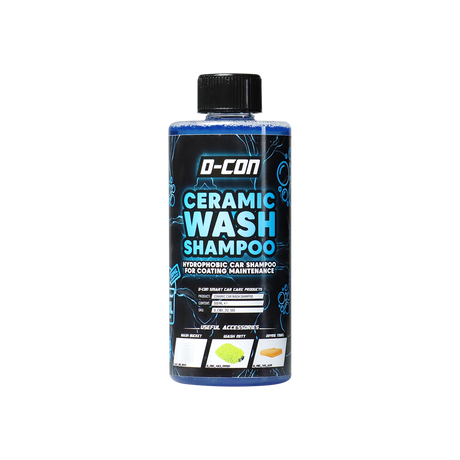
Light defects, few swirls, direct high gloss without a multi-step system: The P2.03 with a polishing grade of 2.0 and a gloss grade of 9.3 is the product for this. It corrects fine defects and imparts direct high gloss in one pass — ideal after spring washing or as a seasonal refresh for well-maintained paint surfaces. If you are at the step before and have not yet made the right shampoo choice, you should start there first — a clean, grease-free surface is mandatory before abrasive polish can be effectively applied.
Experience shows that 250 ml containers are sufficient for several vehicles or multiple correction sessions on the same car. Only a few grams of polish are used per panel area: a hazelnut-sized drop per pad surface is enough. More polish does not extend the correction performance — excess abrasive clogs the pad and has to be painstakingly cleaned after the run. The complete Polishing Collection shows you all products for the entire workflow, from the first cut step to the final finish. The guide to scratch-free drying can also be found in the Detailing101 blog.

No time for the whole post? Get it summarized: