

Stored tyres turn brown because their protection keeps working
In spring you pull the summer wheels out of the cellar, and the sidewalls are coated brown or grey, even though you put them away clean in autumn. Most people reach straight for tyre shine and then wonder why the haze creeps back through after two weeks. A good chunk of that film only forms in storage, and how bad it gets is decided on wheel-swap day.
To store tyres properly, clean the rim and sidewall thoroughly before storage, dry the wheel completely and keep it cool, dark and lying flat or hanging, with no tyre dressing on it. Dressing only goes on once the wheels are back on the car.
The wheel swap is your best chance to clean the wheels
At the seasonal swap you have every wheel free in your hands once a year, and that's exactly when you can reach the rim barrel, the hub and the inner face of the sidewall, which all disappear behind the brake caliper once the wheel is fitted.
The October-to-Easter rule of thumb is only a rough guide. The 7-degree rule is more precise: once temperatures stay below that, the compound of a summer tyre goes hard and loses grip. Since 1 October 2024, only tyres carrying the Alpine symbol (3PMSF) count as winter-capable in Germany, and an M+S marking on its own is no longer enough. So when you bring your winter wheels up from the cellar, check that symbol and the tread depth, not just the sidewall.
Here in Nordhorn it's overcast and damp today. From Friday through Tuesday it stays dry, and Saturday is the window to get it done. That's ideal for washing and drying wheels, because wet rim barrels dry far faster in sunshine and a light breeze than on a grey afternoon. Today is for prep: lay out your products and brushes, find the chalk for marking wheel positions and clear the storage spot.
Before you take the wheels off, chalk each position on the inside of the sidewall, say FL for front left. Next year, put each wheel back on the same side. If you swap front and rear axles, tread wear evens out across the set, as long as your car doesn't run different tyre sizes front and rear. On directional tyres, the arrow on the sidewall shows which way round the wheel goes back on.
Wax blooms in storage while the antiozonant blooms on the road
A brown sidewall is oxidised antiozonant, a greyish-white haze is protective wax that has migrated out. Both protect the tyre against ozone, but both also settle on the surface as a visible film.
The rubber contains 6PPD, an antiozonant that's deliberately mixed in so it can move. It migrates to the surface, grabs ozone there and turns into a brown reaction product in the process. While you drive, the flexing of the sidewall keeps pumping fresh material to the surface.
What that means for you: a wheel that did plenty of miles over summer comes off the car with a brown sidewall, and that film goes down into the cellar with it unless you remove it first. How blooming forms and why it isn't dirt is covered in detail in our post on why tyres turn brown.
When the car stands still, that pump stops. That's why tyre makers also blend in protective waxes that migrate out slowly and form a thin film against ozone. Paraffin waxes migrate most at cool temperatures, peaking at around 20 °C, while microcrystalline waxes only get going at 50 to 60 °C. A cellar shelf sits right in the paraffin range. That's why parked wheels, motorhomes and classic cars often look greyish-white rather than brown. It isn't damage, just a visible protective film.
Why heat is bad news in storage comes down to a simple rule from rubber chemistry: for every 10 °C increase, migration and ageing inside the tyre run roughly twice as fast. A tyre in a sun-baked metal shed at 35 °C therefore ages about four times as fast as one in a cellar at 15 °C. DIN 7716 specifies +5 to +25 °C for storing rubber. So cool isn't just nice to have, it measurably slows ageing down.
The second problem sits on the rim. Brake dust is largely made up of tiny iron particles worn off the brake disc. Leave them in the rim barrel for months and they keep rusting with the humidity, and leftover road salt speeds that up. Put simply: what would still wipe off as a grey film in October can be stuck in the rim's clear coat as embedded specks by April.

Clean the rim first, then the sidewall, then dry everything
With the wheel off the car, the right order is rim first, sidewall second, then dry completely. That way no loosened brake dust runs over the sidewall you've already cleaned, and no moisture goes into storage with the wheel.
Stand the wheel upright on a rubber mat or lay it flat on a clean surface, rinse off the loose dirt and let the rim cool down if it has just come off the car.
Spray an acid-free, colour-changing wheel cleaner onto the cold, dry rim, on the face and in the barrel. After 30 to 60 seconds it turns red-violet wherever iron in the brake dust reacts. After 2 to 5 minutes, rinse from top to bottom. On heavily contaminated rims, two short passes beat one long one.
Then it's the sidewall's turn. Spray the tyre cleaner onto the wet sidewall and work it in with a stiff brush in several directions. On the first pass the foam comes up brown to grey, because it's lifting exactly that film of 6PPD residue, wax and old dressing. Rinse and repeat until the foam stays white while you brush. Only then is the sidewall properly bare. The first wheel takes longer than you'd expect. By the fourth, you've got the rhythm.
When rinsing, keep the pressure washer lance at least 50 cm from the sidewall, and the rotary nozzle, often called a dirt blaster, has no business near a tyre. A concentrated pencil jet can overstretch the rubber locally, and water gets through tiny cracks to the steel belts inside. You can't see that from the outside, and it only becomes a problem months later.
Drying is the step that most often gets rushed. Water sits in the bolt holes, in the rim barrel and where the tyre meets the rim. A drying towel handles the flat surfaces, a blower gets into the corners. After the wash, allow another night for the wheels to dry uncovered and lying flat. A wheel that goes into a sealed bag damp spends months sitting in its own moisture.
These products get a set of wheels clean
To prep a set of wheels for storage you need an acid-free wheel cleaner, a cleaner for sidewall and rim, two wheel brushes and, for later, a water-based tyre dressing.
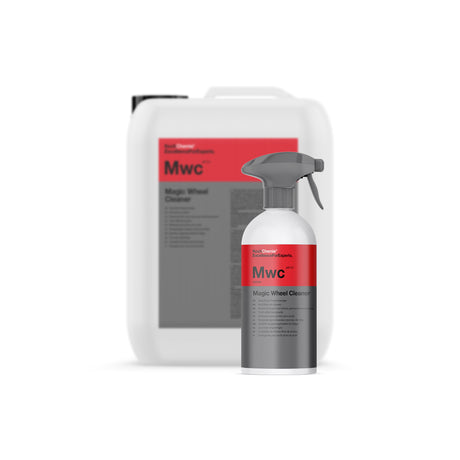
For the rim, the Koch-Chemie Magic Wheel Cleaner "Mwc" 500 ml is the obvious pick. It's acid-free, sits at pH 5.5 according to the label and dissolves the iron in brake dust, showing it with a red-violet colour change. 40 to 50 ml per wheel is enough, so one bottle covers a good two sets of wheels. On Trusted Shops it has nine verified customer reviews, one of which singles out how quickly it reacts. Its limit: it works on iron. It won't shift baked-on tar and bitumen, for that you need a tar remover.
For the sidewall and the rim face we go with the Soft99 Digloss Kamitore Wheel and Tire Cleaner. It's designed to clean wheel and tyre in one go and takes brake dust, road film and old tyre dressing off the sidewall. The 800 ml bottle with its long trigger grip lasts several sets of wheels. On delicate, polished or matte-finished rims, test it first on a hidden spot. That goes for any cleaner that isn't explicitly pH-neutral.
To get into the rim barrel and between the spokes, use the Koch-Chemie Wheel Brush Set 2-teiliges Set / Klein + Groß / Nylonborsten. The large brush cleans the deep barrel from the inside, the small one the tight gaps between spokes and the wheel bolt holes. The brush spreads and lifts the loosened dirt, the chemistry has already done the heavy lifting. If you want to dig deeper into the order of work, you'll find the details in our post on why the cleaning order decides how long your tyre dressing lasts.
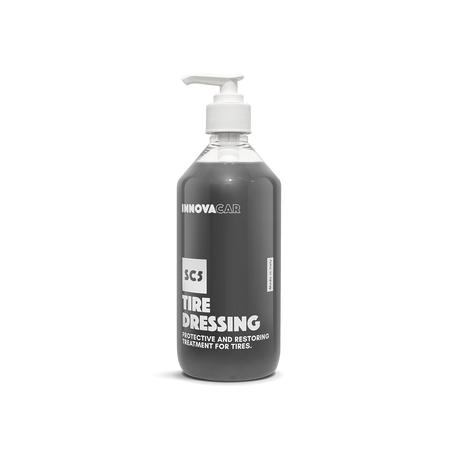
Dressing only goes on after fitting. INNOVACAR "SC5" Tire Dressing 500 ml is water-based with SiO₂, goes on neat or diluted up to 1:3 with water, and you wipe off any excess after 15 to 30 minutes. Diluted it gives a satin finish, neat it gives more depth. For an overview of other cleaners, head to the wheel and tyre cleaning category, and you'll find matching dressings under tyre care.

Bagging wheels wet and dressing them first makes it worse
If you want to store tyres properly, there are four mistakes above all to avoid. Most of the damage to stored wheels doesn't come from a lack of care, but from moisture, heat, ozone and tyre shine applied before storage.
The most common mistake is the thin plastic bag from the tyre shop. It keeps your boot clean, but in the cellar it traps every last bit of moisture. Inside, a microclimate close to 100 per cent humidity builds up, mould grows on leftover dirt, and at stone chips and kerb rash the moisture can creep under the rim's paint. If you want to cover the wheels, use breathable fabric tyre bags, and only once everything is dry.
The second mistake is well meant. Spraying tyre shine on the freshly cleaned sidewall before winter usually does the opposite of what you want. Solvent-based silicone dressings can pull plasticisers and protective waxes out of the rubber. That's why tyre makers such as Continental and Michelin explicitly advise against treating tyres with shine products before storage. Water-based dressing doesn't harm the rubber, but in a dark storage room it does nothing either, because no UV light, rain or road grime ever reaches the sidewall there.
The third mistake is where you store them. Boiler rooms, utility rooms and the spot next to the compressor are poor choices, because electric motors with carbon brushes generate ozone, rubber's number one enemy. Add the heat from the boiler on top. Fuel, oil, solvents and paints don't belong next to the wheels either. Rubber swells and softens when fumes like that work on it for months.
The fourth mistake happens on the rim: harsh, acidic wheel cleaner right before storage. Residue in the gap between tyre and rim flange then keeps working for half a year. Acid-free cleaners, a thorough rinse and complete drying prevent that.
Store them cool, dark and flat and dress them at fitting
To store tyres properly, above all: stack complete wheels lying flat, no more than four high, or hang them by the rim. Tyres without rims stand upright and get a quarter turn every four weeks.
If you want to store tyres properly, the right room matters most. The ideal storage room holds 10 to 15 °C, is dark, dry and well ventilated, with no more than 65 per cent relative humidity. Keep at least a metre away from radiators and warm pipes. Very dry heated air below 30 per cent isn't good either, which is why a cool cellar beats a heated room.
Before storage, pump complete wheels up to about 0.5 bar above the manufacturer's figure. Over the months the tyre slowly loses air through diffusion, and this way it isn't sitting on a flat spot come spring. When stacking, a layer of cardboard between the rims protects the finish, and if you restack the pile every few months, the load is shared across all four wheels. With tyres off the rim it's the other way round: lying flat would squash the beads, so they stand upright side by side.
At fitting, check tread and age first. The DOT number on the sidewall gives the production week, 3421 stands for week 34 of 2021. After eight to ten years a tyre should be replaced regardless of tread.
After the first 50 to 100 km, re-torque the wheel bolts with a torque wrench. Only now, when the tyres are exposed to UV light, rain and road grime again, is a water-based dressing worth it. If a light grey haze from storage is still there, a quick cleaning pass on the sidewall before the dressing goes on is all it takes.
That way the wheels go from shelf to car clean in spring: a bare sidewall with no brown layer, a rim barrel with no rust specks and rubber that has spent the winter cool and dark. The dressing then goes onto a clean surface and lasts that much longer.

Jasper's hands-on tip: Before a wheel goes into its bag, I give the sidewall one firm wipe with a dry, light-coloured microfibre towel. If the towel stays clean, the sidewall is done. If it shows a brown streak, there's still oxidised antiozonant on the rubber, and the wheel gets another round with cleaner and brush. After that, all four wheels lie uncovered on cardboard overnight, and only the next morning do they go into breathable bags. A sealed bag over a still-wet rim barrel locks the moisture in until spring.
No time for the whole post? Get it summarized: