

Two Buckets, One Principle: How to Wash Without Scratches
Saturday afternoon, sun shining, garden hose ready — and after ten minutes of scrubbing with one bucket, the paint looks clean. Until you hold it up to the light. Then you see them: hundreds of fine circular scratches, so-called swirls, that get deeper with every wash. The problem is almost never the shampoo. It's the one bucket.
The two-bucket method separates clean water from dirty water. It is the foundation of every professional hand wash — and the easiest way to keep your paint scratch-free long-term. In this article, you'll learn why one bucket isn't enough, what you need, how the process works, and what mistakes you should avoid.
One bucket causes scratches. Two prevent them.
The principle of the two-bucket method can be summarized in one sentence: Wash the dirt off your mitt before you pick up fresh shampoo.
If you work with a single bucket, you dip the wash mitt back into the same shampoo solution after each pass. This releases dirt—sand, brake dust, mineral dust—from the mitt, spreads it in the water, and then re-adheres to the fibers with the next dip. These very particles are then dragged across the clear coat. The result is micro-scratches that become visible as circular holograms in sunlight. Professionals call them swirl marks.
The solution is remarkably simple: A second bucket with clean water stands next to the shampoo bucket. After each wash pass, you first rinse the mitt in the clean water, rub it against the grit guard at the bottom of the bucket—and only then dip it into the shampoo solution. The dirt remains trapped under the guard, and the shampoo water stays clean. A cycle that ensures no grain of sand ever gets between the mitt and the paint.
Especially now in April, this method is particularly relevant: Saharan dust and birch pollen settle on the paint as an aggressive mineral layer. Anyone who washes off this coating with a single bucket is grinding quartz grains across the clear coat. The two-bucket method in such situations is not an option—it's a necessity.
By the way: Professional detailers invariably use at least two buckets. Not because it's a rule, but because they see the difference in the paint every day. What is self-evident for professionals, you can integrate into your wash process in 30 seconds.
What you need: The equipment at a glance
For the two-bucket method, you need exactly five things—no more, no less.
First: Two buckets with a minimum capacity of 15 liters. 20-liter buckets like the Koch-Chemie Detailing Bucket are ideal because they are deep enough to completely immerse the mitt and a perfectly fitting grit guard is available. Different colors help to avoid confusing the buckets in your workflow—black for shampoo, another for clear water is a proven assignment.
Second: One grit guard per bucket. The Grit Guard lies at the bottom and traps dirt particles under the grid. Without a guard, every hand movement stirs up the settled sand again. Technically, the guard is the crucial difference between a genuine two-bucket method and merely transferring dirty water.
Third: A high-quality microfiber wash mitt. The Koch-Chemie Exterior Wash Mitt with 640 gsm microfiber is soft enough to trap particles instead of pushing them, and has an ergonomic inner seam for a secure grip. Important: Never use a sponge—its flat surface presses dirt particles directly against the paint, instead of absorbing them between the fibers.
Fourth: A car shampoo with good foaming performance. The Koch-Chemie Car Shampoo "As" is ideal for hand washing with its high foam production. The foam forms a glide layer between the mitt and the paint—the denser the foam, the lower the friction. Dosage for hand washing: about 10 ml per bucket at a dilution of approximately 1:150.
Fifth: Running water for pre-rinsing and rinsing. A garden hose is sufficient, a pressure washer is better. Optional, but recommended: a foam lance for pre-washing with Koch-Chemie Gentle Snow Foam. How to use Snow Foam correctly is described in detail in the article How to use Snow Foam correctly.

From top to bottom: The first wash passes
The order of washing follows a simple physical principle: dirt and water flow downwards. Therefore, you always start at the roof and work your way down over the hood, doors, and side panels.
Before the wash mitt touches the paint, there's the pre-wash. Thoroughly rinse the entire vehicle with a hose or pressure washer to remove loose dirt, dust, and coarse particles. If you have a foam lance, apply Snow Foam after rinsing and let it dwell for three to five minutes. The foam chemically dissolves bound dirt so you don't have to mechanically rub it off the paint. After that, rinse off the foam—and only now does the actual hand wash begin.
Dip the wash mitt into the shampoo bucket, soak up plenty of foam, and place the mitt flat on the roof. Move it in straight, overlapping passes from front to back—no circular motions. Circles spread particles over a larger area and increase the risk of scratches. Straight passes remove dirt in one direction.
Apply minimal pressure. The shampoo and microfiber do the work. If a spot doesn't come off on the first pass, the answer isn't more pressure, but a second round with fresh shampoo. After each section—i.e., after the roof, left side, right side, rear—thoroughly rinse the mitt in the clear water bucket against the grit guard before picking up new shampoo.
The bottom 20 centimeters of the vehicle—sills, wheel arches, bumpers—are the dirtiest areas. Always wash them last and ideally with a separate mitt or microfiber towel that you only use for this area. This prevents coarse road dirt from the bottom from transferring to the already clean surfaces above.
Rinse, dry, finish — securing the result
After hand washing, rinse the entire vehicle thoroughly from top to bottom with clear water. Pay particular attention to crevices, door edges, and mirrors, where shampoo residues can collect.
Do not let the car air dry. Tap water contains lime and minerals that leave white spots on the paint as they evaporate—so-called water spots. With hard water, which is common in many German regions, these spots can etch into the clear coat if they dry in the sun.
For drying, use a large microfiber drying towel with at least 600 gsm. Lay it flat on the wet surface, pull it slowly towards you, and let the microfiber absorb the water. No wiping, no pressing—just pulling. This method is called "Pat Dry" in detailing jargon and minimizes any mechanical friction.
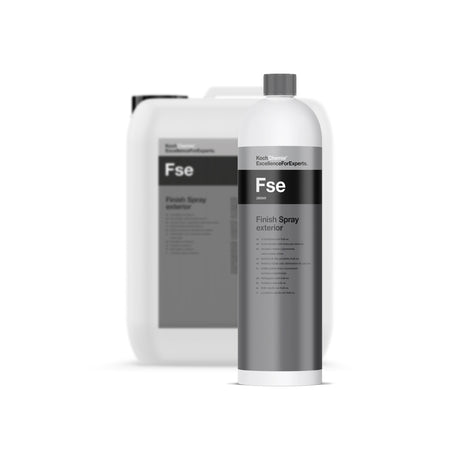
Optional, but recommended: After drying, spray a quick detailer like the Koch-Chemie Finish Spray Exterior "Fse" onto the paint and wipe it off with a fresh microfiber towel. The quick detailer removes any remaining lime residue, smooths the surface, and leaves a subtle shine. With regular use, it builds a light protective layer that repels water and dirt better.

Five mistakes beginners pay dearly for
The most common mistake is also the most invisible: too little pre-washing. Anyone who places the mitt on a dust-covered paint without rinsing first is dragging hundreds of particles across the surface. A thorough pre-wash—at least rinsing, ideally with Snow Foam—removes 70 to 80 percent of the dirt before you even touch the paint.
Mistake two: circular motions when washing. They feel natural but spread dirt particles over a maximum area. Straight passes in the direction of travel are more effective and safer. If you want to remember one rule: wash as the wind moves over the car—lengthwise, not crosswise.
Mistake three: dropping the mitt and continuing to use it. As soon as a microfiber wash mitt has touched the ground, it is contaminated. Sand, small stones, grit—everything immediately adheres to the fine fibers. The only correct reaction: set the mitt aside, take a fresh one. That's why it's worth always having a spare mitt at hand.
Mistake four: washing in direct sunlight. UV radiation and heat make shampoo and water evaporate faster than you can work. This leads to streaks, smears, and in the worst case, baked-on shampoo residues. The ideal washing time is in the morning or evening, on a cloudy day, or in the shade. If the surface is hot enough that you cannot comfortably touch it, it is too hot to wash.
Mistake five: using the wrong towel for drying. Chamois leathers, cotton towels, or old bath towels have no dirt absorption capacity—they push residual particles across the paint. Only long-pile microfiber towels with a high GSM absorb water without touching the surface. A drying towel with 600 gsm or more is not a luxury investment, but basic equipment.
Your Starter Setup: Five Products, No Compromises
To get started with the two-bucket method, you don't need a warehouse full of specialized products. Five components are enough for a professional, scratch-free wash—and you already know them all from the steps above.
The core consists of two Koch-Chemie Detailing Buckets, each with a grit guard. The 20-liter buckets are deep enough to fully immerse the mitt, and the matching Grit Guard sits securely at the bottom. Together with the guard, the setup costs less than a professional polish—and prevents you from needing one. When purchasing, look for buckets with reinforced rims and sturdy handles, as 20 liters of water weigh 20 kilograms.
For shampoo, rely on Koch-Chemie Car Shampoo "As". It produces dense, long-lasting foam and cleans thoroughly with a dosage of about 10 ml per bucket. A note for honesty: "As" has a pH value of about 9—it is mildly alkaline and can strip wax layers with regular use.
For vehicles with ceramic coatings, we recommend a pH-neutral shampoo from our shampoo collection. For uncoated vehicles or those that are regularly re-waxed anyway, "As" is an economically sensible choice—phosphate-free, efficient, and formulated with a combination of anionic and non-ionic surfactants that reliably dissolve both greasy road film and mineral deposits.
The Koch-Chemie Exterior Wash Mitt with 640 gsm microfiber forms the contact point between your hand and the paint. Its long fibers pick up dirt particles and keep them away from the paint surface. The central inner seam ensures that the mitt does not slip even when wet.
After each use, wash the mitt at a maximum of 30 degrees without fabric softener—fabric softener clogs the microfibers and destroys their cleaning effectiveness. It's best to buy two mitts directly: one for the upper vehicle areas, one for the dirt-intensive zones such as sills and wheel arches.
Optional, but a useful upgrade: Start the wash with a foam pre-wash using Koch-Chemie Gentle Snow Foam. The pH-neutral foam dissolves road film, insect residues, and pollen without attacking sealants. In our article on spring cleaning, we explain why pre-washing is so crucial, especially after winter. Once you have Snow Foam in your workflow, you won't want to leave it out—the difference in cleanliness after hand washing is noticeable.
And finally: the quick detailer. The Koch-Chemie Finish Spray Exterior neutralizes lime spots during drying and gives the paint a smooth, water-repellent surface. Two sprays per panel, distribute with a clean microfiber towel—done. It transforms a good wash into a result that feels freshly sealed. In the long term, the quick detailer builds a thin protective layer with each application, keeping the paint hydrophobic between larger sealants.
Try it. Two buckets, one system, no scratches. The investment is manageable, the effect on your paint is not.

No time for the whole post? Get it summarized:
Add Detailing1 as a preferred source on Google