

Polishing a car by hand or by machine
We get this question almost every day, and almost always in the same words: is hand polishing enough, or do I really need a machine? Answer it wrong and you either burn a whole weekend or you burn through clear coat that never grows back. Because there is exactly one class of polish that, worked by hand, provably does more damage than it fixes.
Hand polishing and machine polishing don't differ in the gloss you can reach, but in the depth of defect you can reach. On light wash marks the two give you the same picture. From medium depth on, the hand taps out, and from there it's rpm that decides.
The wrong call costs you a weekend or costs you clear coat
Polishing is sanding for gloss. Fine abrasive particles take off a whisper-thin layer of clear coat until the edges of a scratch lie flat enough that light reflects evenly again instead of scattering.
That's why the tool question isn't a matter of taste. A scratch is a valley in the clear coat. Either you level the surroundings until the valley disappears, or you only knock the edges off it and win back gloss without actually removing the defect. Both are legitimate goals. They just need different amounts of energy at the surface, and that energy is exactly what separates hand from machine.
The quick pre-check takes ten seconds. Run a fingernail across the scratch. If the nail catches, the defect goes deeper than the clear coat, and neither hand nor machine will save it. If the nail glides flat over the top, you're in correctable territory, and the real question only starts there.
There's a seasonal reason the question comes up more often right now. Demand for dual action polishers sits at an index of 67 in August, which puts it in the top third of the year; March marks the annual peak at 91. Over the last eight weeks the curve is running 7.6 percent above the twelve-month average and still climbing. After a summer of bug splatter, tree sap and motorway miles, you start looking at your paint a lot more closely.
Hand polishing buys gloss, not depth correction
By hand, a whole car goes round in a good hour, as long as the defects are light and you're working with an all-in-one polish. Deep scratches, though, provably stay in the paint.
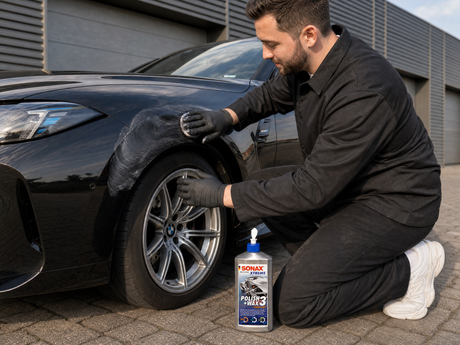
The mechanics are simple, and still the point where most people come unstuck. By hand you replace the missing speed with pressure and short strokes. Pull long passes and you lose the contact pressure halfway across, then wonder why the result looks patchy. So work a test patch of 40 by 40 up to 50 by 50 centimetres, and budget one dose of polish for roughly the area your own forearm covers, squared.
What actually happens can be put in numbers: a finishing or medium polish worked by hand takes off less than 0.5 micrometres of clear coat per pass. That's very little, and that's the good news — the route is forgiving. What you pay for it is consistency. Ideal contact pressure when polishing sits at 15 to 25 kilopascals, and a machine holds that almost constant through its own weight, while under your hand it swings hard from spot to spot. That's why hand work goes patchy the moment your concentration slips.
One pass is a cross-hatch: once fully horizontal, once fully vertical. You repeat it until the milky film on the paint turns clear. That colour change isn't a cosmetic detail, it's your stop signal — from there the abrasives have broken apart, all that's left is carrier fluid, and carrying on gets you nothing.
Be generous on the first pass, because a dry applicator soaks up product first. From the second one on, four or five pea-sized blobs are plenty.
What you need for this is less than most people think, but it isn't interchangeable. The Koch-Chemie "Puck" hand polishing applicator, 77 by 47 millimetres, sits solid in the palm and lets you build pressure without tipping onto an edge. A kitchen sponge can't do that: it drinks too much polish, gives it back uncontrolled and leaves streaks.
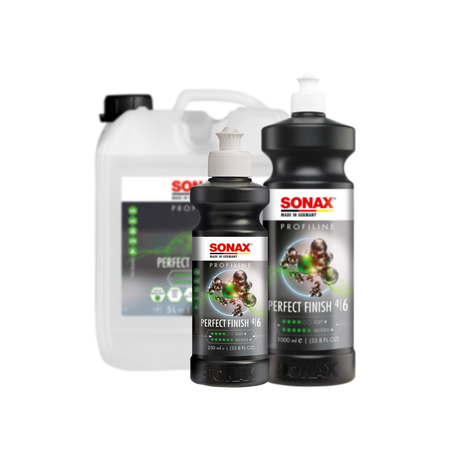
For polish, this route wants a fine grade like the SONAX PROFILINE PerfectFinish "4/6" finishing polish, calibrated at cut 4 and gloss 6 on the maker's own scale. A whole car by hand burns through roughly a quarter to a third of a bottle, so one bottle covers about three cars.
One thing almost everyone underrates, and it costs nothing: light. Under normal warehouse or garage lighting you see neither the swirls nor your own progress, least of all at a shallow angle. Without a paint inspection lamp you're polishing blind, and you typically stop too early, often after twenty seconds, while the abrasive hasn't broken down at all yet. To start with, a bright LED torch or your phone light held at a grazing angle does the job. And always work on clean paint, free of tar and iron fallout, or you'll grind dirt particles straight into the surface.

The dual action works with speed, not with pressure
A polisher turns a few hundred revolutions per minute at the bottom end and a few thousand at the top. That relative speed is simply out of reach by hand in any realistic amount of time.
That figure translates into the number that really counts when you polish: how fast the abrasive travels across the paint. By hand, at about three circular movements per second, you get to roughly 0.94 metres per second. A dual action with 15 millimetres of throw at 4,500 oscillations per minute sits at about 3.53 metres per second; a rotary with a 125 mm backing plate at 1,200 revolutions hits 7.85 at the pad edge. Cut follows the product of pressure and speed, and speed is the factor you can't buy with your arm.
That's where the real difference comes from, and it isn't cut alone — it's the finish. Modern polishes run on diminishing abrasives: the grit starts coarse and breaks down under working time and friction heat into ever finer particles, until it polishes rather than cuts. The machine delivers that working time in seconds. Which is why Koch-Chemie explicitly says, for one-step use, to spread the polish across the panel on the lowest setting first, so the particles only start breaking down there, and to step the speed up after that.
In practice: five pea-sized drops on the pad, spread on setting 1, then up to working speed 3 to 4. A typical entry-level machine runs 15 millimetres of throw. Your stop signal here isn't milky-to-clear, it's the oil phase — the dull white film flips into a glossy, oily, even one. Which type of machine suits you we pulled apart in Dual action or rotary; pad choice follows paint hardness and polish grade.
The machine does have a weakness nobody talks about much: it can't reach everywhere. A 150 millimetre backing plate won't go near an A-pillar, into a swage line or around a mirror base. If you still want to do those by machine, you need a small backing plate and, in practice, often a second machine. Then there's wear: pads lose hardness and bite far faster on a machine than in your hand. Three to four pads per car is realistic, not one.
Before the machine touches paint for the first time there's a step in between that you can more or less skip by hand. Mask off plastics, rubber seals and trim, because dried polish barely comes back out of matt black, and a cutting pad leaves marks there you won't fix. Beyond that it's as much as needed, as little as possible, since adhesive residue lifts while you polish and can pull fresh scratches on soft paint. Run the cable or the battery over your shoulder so nothing drags across the panel you just finished.
Four scenarios and what each one asks for
The honest answer to the tool question isn't hand or machine, it hangs on the defect. Four situations cover almost everything that turns up in real life.
| Situation | By hand | By machine |
|---|---|---|
| Light wash marks, dull paint | covers it completely | faster, no better result |
| Holograms after someone else's polish | tends to make it worse | the only clean route |
| Deep scratches in the clear coat | effectively impossible | doable, at the cost of material |
| A-pillar, swage line, mirror base | clearly ahead | needs an extra backing plate |
Read in micrometres, the table gets even clearer. Hand polishing stays under 0.5 micrometres per pass; a dual action with finishing polish sits at 0.5 to 1.0, with medium cut at 1.0 to 2.0, and with heavy cut at 2.0 to 3.0 micrometres.
For scale: the total paint build on a production car measures just 100 to 160 micrometres, and the clear coat often accounts for around 45 of those. The critical line is 70 percent remaining — push a 45 micrometre layer below 25 and you're risking clear coat that flakes off later.
The machine's time advantage is smaller than the price difference suggests. In a head-to-head test on one panel, the machine covered twice the area and saved a grand total of 20 seconds; on the second section it was exactly as fast. Both routes needed two passes, and both still showed residue after the first. Scaled up to a whole car an advantage remains, but it's no landslide.
More telling still is the result itself. With the same polish, hand and dual action finished level on the test panel, and the machine showed nothing better. That was backed up by degreasing both sides twice, so no fillers could fake the outcome. That control step is exactly what most home attempts skip, which is why so many people mistake a filler look for real correction.
In practice: if your paint only looks flat and shows fine round swirls under raking light, you don't need a machine to get a visibly better car. If raking light shows directional hazing instead, or your nail is already close to catching, hand polishing buys you work and no result.

Where each method has its own weak spot
A heavy cutting polish worked by hand creates holograms of its own, because without machine running time the abrasive never breaks down to finishing grade and works the paint at full sharpness.
That's the mistake flagged at the top, and it's well documented. In a hands-on test on neglected paint with around 168,000 kilometres on it, the aggressive polish by hand was the one that left visible polishing marks and a grey haze, while the medium polish on its own gave the better result. The explanation sits in the grit: by hand you don't get the running time that rounds it off. So working by hand you start one grade more aggressive than you would on the machine, but never in the heavy cut class.
Once the haze is there, only the machine gets it out. Koch-Chemie Micro Cut "M2.02" high gloss anti-hologram polish is built for exactly that and pulls out holograms, polishing haze and fine scratches from 4,000 grit upwards. It's free of silicone oils, which matters when a sealant is going on afterwards. How to get that finish repeatably is in Finishing hologram-free.
The machine has its own weak spot, and it's a matter of physics. On sharp edges and raised swage lines the clear coat flows away during spraying, so the factory layer is thinnest there — exactly the places a spinning pad burns through first. And on plastic parts it gets thermally tight: clear coat on bumpers cures at 70 to 90 degrees Celsius, plastic insulates friction heat instead of conducting it away the way steel does, and from 60 to 70 degrees component temperature the coating closes in on its glass transition. In both spots the hand isn't the compromise, it's the technically correct call.
The third weak spot belongs to both routes, and it isn't the tool, it's the cloth. A question we get regularly: can you use both sides of a towel? You can, but only until it's saturated. A soaked cloth stops picking polish up and starts pushing it around the paint, and the result looks like smears.
So plan on three to four cloths per car. Short pile and edgeless is non-negotiable, something like the THE COLLECTION "Allround / Coating 300" short-pile edgeless microfibre cloth at 300 g/m² with a 70/30 fibre blend, whose dense structure picks the residue up instead of spreading it. More options sit in the microfibre cloths.
That leaves the most uncomfortable truth, and it hits both routes again. Plenty of all-in-one products don't only correct, they fill as well. Removing means taking clear coat off, and it lasts. Filling means fillers sitting in the groove, and weather and wash cycles rinse them straight back out.
The only reliable test is a panel wipe or isopropanol after polishing: what's still there afterwards was real correction. What disappears was looks on loan. Hardly anyone does this step, and that's exactly why the scratches seem to come back on their own after four weeks.
Your Sunday decides which tool you need
If you want to brighten one car up twice a year, your hand is enough. If several cars come round several times a year, the machine pays for itself inside the first year.
Today isn't the day for it anyway: 15 degrees, solid cloud cover, 0.3 hours of sun and rain on the hour. Polishing wants dry, low-dust and above all cool paint, because in the sun the polish dries hard and bakes on. The long working window comes on Sunday. Today is the day you decide what's laid out for Sunday, so you don't get halfway across a panel and realise the third cloth is missing.
The decision itself boils down to two sentences. If your goal is gloss on fundamentally healthy paint and you're working pillars, swage lines and edges specifically, grab the "Puck" plus a fine polish and set aside a good hour. If your goal is correction, if holograms, directional hazing or medium scratches are in play, or if more than one car comes round on a regular basis, there's no way past a dual action, something like the FLEX "XFE 2 15 18-EC" cordless dual action polisher with exactly the 15 millimetres of throw that counts as the entry-level figure.
For getting into the machine without the two-step effort, a one-step polish is the most pragmatic route, something like the ZviZZer One Polish one-step polish, which pulls correction and finish into a single pass. For the pure hand route the 250 ml size stays the sensible pick; at that rate of use it covers around three cars. The full range for both routes sits in the polish category.
Over 1,239 verified product reviews at an average of 4.7 on Trusted Shops now stand behind our selection, though individual specialist items like the hand polishing applicator are still too new for meaningful single ratings.

Detailing1 insight: At the showroom in Nordhorn we deliberately polish on two tracks, on the same car. The flat panels run with the dual action; the A-pillar, the mirror bases and the swage line under the door edge we do by hand with the "Puck", because a 150 mm plate simply doesn't get in there. The most expensive mistake we see with customers is the other way round: one customer had worked a black door with a heavy cut polish by hand and ended up with grey haze across the whole panel, which cost us a full machine round with the M2.02. If you only have one tool, pick the polish to match it, not the other way round.
No time for the whole post? Get it summarized: